
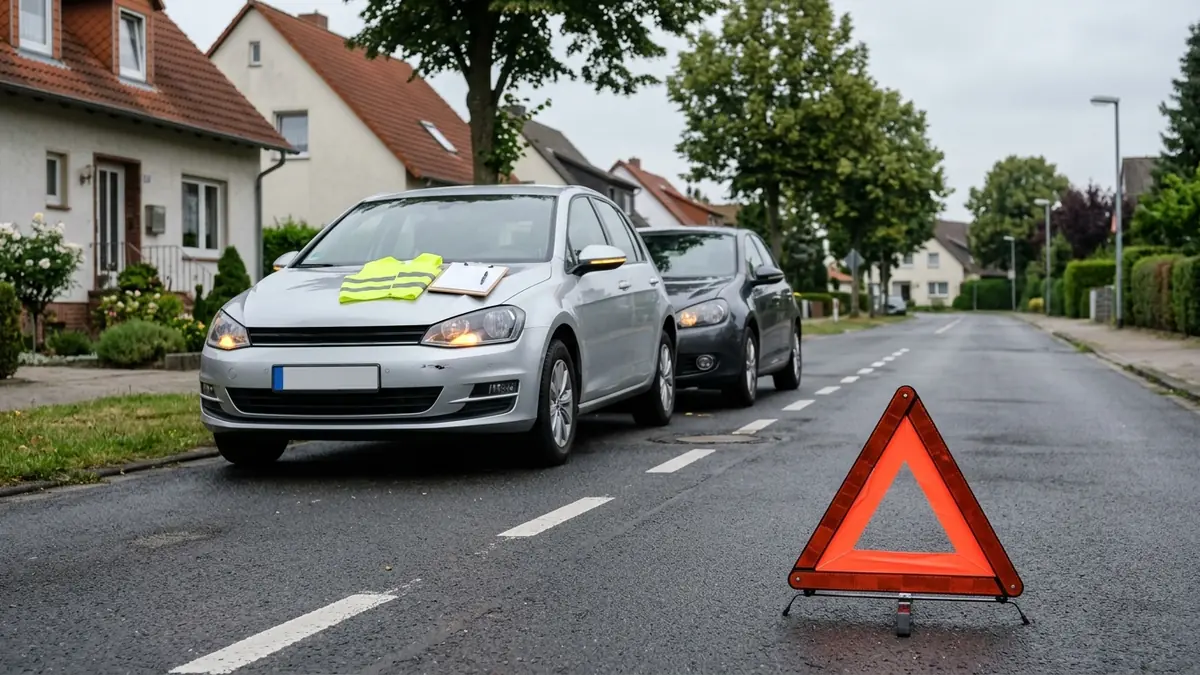
After a car accident, the first few minutes decide how easy or how painful the next weeks will be. If you secure the scene properly, collect evidence and do not sign the wrong thing, you usually get your damage paid without a fight. This guide explains what German law expects from you at the scene, when to call the police, what to get done within 24 hours and which rights you have when the other driver was at fault.
The first minutes: stop, secure, help
After an accident you must stop immediately, secure the scene and look after anyone who is hurt. This is set out in § 34 of the German road traffic regulations (StVO), and failing to help injured people is a criminal offence under § 323c StGB. The order is always the same:
- Hazard lights on, safety vest on: Put the vest on before you get out, and bring passengers behind the crash barrier or onto the pavement.
- Set up the warning triangle: About 50 metres behind the scene in town, about 100 metres on country roads and at least 150 metres on the Autobahn. Before a bend or a hilltop, place it so that traffic behind sees it in time.
- Help the injured and call 112: Even with neck pain or a headache, rather call the ambulance once too often. The police number is 110.
- Clear the road if the damage is minor: If nobody is hurt and the damage is small, you must move the cars out of the way straight away (§ 34(1) no. 2 StVO). Take two or three quick photos of where the cars ended up first, if that is safe.
Then stay at the scene. You have to tell the others involved that you were part of the accident and, if asked, give your name, address, driving licence, vehicle registration document and your insurer. If you drive off before that, you commit the offence of leaving the scene of an accident (unerlaubtes Entfernen vom Unfallort, § 142 StGB). This also applies when you scrape a parked car: a note under the wiper is not enough. You have to wait a reasonable time and then inform the owner or the nearest police station without delay. Apart from criminal proceedings, your own motor liability insurer may claim up to 5,000 euros back from you (§ 6(3) KfzPflVV), and your comprehensive cover may refuse to pay for this damage altogether.
Call the police or not?
If there is only damage to the cars and nobody is hurt, you do not have to call the police. Many small accidents are settled between the drivers using the European Accident Statement (Europäischer Unfallbericht), and that works well as long as both agree on what happened. Call the police anyway in these cases:
- Somebody is injured, even slightly.
- The other driver refuses to give their details or has no driving licence or vehicle papers with them.
- You suspect the other driver has been drinking or taking drugs.
- You disagree about who was at fault, or the other driver changes their story.
- A car with foreign plates, a rental car or a company car is involved.
- The damage is high, or a car has to be towed away.
- You do not feel confident handling the situation in German. The officers record the facts, and you can ask for the report in writing later.
The police record the accident, note witnesses and traces and give you a reference number (Aktenzeichen). Your insurer can then request the investigation file. If one of the drivers gets a fine on the spot, that is not a ruling on fault for the insurers, but they will read it.
Secure evidence while everything is still there
What you record in the first twenty minutes cannot be collected later. Skid marks disappear, witnesses drive off, and memories change surprisingly fast, including the other driver's.
- Photos: An overview from several directions, the final position of the cars, every damaged part up close, registration plates, skid marks, debris, traffic lights and road signs. Fifty photos too many are better than one too few.
- The other driver's details: Name and address of the driver and of the registered keeper if they are different, registration number, insurer with policy number, type of vehicle. A photo of their driving licence and registration document is the easiest way, if they agree.
- Witnesses: Name and phone number before they leave. Independent witnesses are worth a lot, because one statement against another often ends with the damage being split.
- Accident statement: The European Accident Statement records the details and what happened and is signed by both drivers. Only tick what is true and do not write anything about fault. Take a photo of the completed form. Many insurers also offer it as an app, often in English.
- Dashcam: German courts may use dashcam footage as evidence (Federal Court of Justice, judgment of 15 May 2018, VI ZR 233/17). Save the file before it gets overwritten.
A word on admitting fault: do not say or sign that you were to blame, even if it seems obvious in the moment. "Sorry, are you okay?" is human and not an admission. "It was my fault, my insurance will pay" is. An admission does not automatically cost you your cover (§ 105 VVG), but it does not bind your insurer either. If the real legal position means it has to pay less than you promised, you may be left with the difference. Whether and to what extent you are liable is for your insurer to sort out.
Also watch out for tow trucks and assessors who turn up at the scene without being called. Do not sign any orders there and do not assign your claims to anyone. If your car needs to be towed, call the emergency number of your motor insurer or your breakdown cover (Schutzbrief). It is usually on your insurance card or in the app.
An example: Ananya at the roundabout
Ananya, 34, works as a software developer in Münster and has had her own car for just over a year. One Tuesday morning a delivery van drives into her passenger door at a roundabout. The driver gets out, apologises and suggests sorting it out without the police. He writes a phone number and a registration number on a piece of paper and wants her to sign his form saying that neither of them was paying attention.
Ananya does not sign. She photographs the cars, the marks on the road and the van's plate, asks a cyclist who saw everything for her number and calls the police, because the driver has no vehicle papers with him. The officers record the accident and give her a reference number.
That evening it turns out the registration number on the note has two digits swapped. Using her photo, Ananya still finds the van's insurer through the Zentralruf der Autoversicherer. Because the damage is well above the minor damage threshold, she hires her own assessor, has the car repaired at her garage and receives compensation for loss of use for the ten days without a car. The van's liability insurer pays for all of it, and her own no-claims class is not affected.
The next 24 hours: report and document
Once the car is at the garage or back home and the first shock has passed, the paperwork starts. Most of it can be done the same evening.
- Find the other driver's insurer: If you do not have it or something does not add up, the Zentralruf der Autoversicherer helps. With the registration number, date and country of the accident it tells you the responsible motor liability insurer. Free within Germany on 0800 250 260 0, from abroad on +49 40 300 330 300 or online at zentralruf.de.
- Inform your own insurer: The model conditions of the German Insurance Association (GDV) require you to report every incident that could lead to a claim within one week. What counts are the conditions of your own policy. Report the accident even if you think you were not at fault and the other driver might make claims. A report is not yet a downgrade.
- Claim from the other side: If you were not at fault, you claim your damage directly from the liability insurer of the driver who caused the accident. You have a direct claim against that insurer (§ 115 VVG). Write factually, with date, place, what happened, the police reference number and photos. How to set this out is explained in the guide How to file an insurance claim.
- See a doctor if anything hurts: Neck pain after a rear-end collision often only starts the next day. Get checked soon. A medical report shortly after the accident carries a lot of weight for compensation for pain and suffering and lost earnings, one three weeks later hardly any.
- Inform the leasing company or bank: If the car is leased or financed, the contract usually requires a quick report, and the leasing company often has a say in how the car is repaired.
The other driver was at fault: what you are entitled to
After an accident that was not your fault, the other driver's liability insurer has to put you in the position you would have been in without the accident (§ 249 BGB). Many people get less than they are entitled to because they do not know what they can ask for.
- Your own assessor: You may hire a vehicle assessor of your choice, and the other side's insurer pays the fee. The exception is minor damage: if the damage is clearly below roughly 750 to 1,000 euros, courts usually consider a repair estimate sufficient. You do not have to accept the assessor the other side's insurer sends.
- Free choice of garage: You decide where the car is repaired. You can turn down offers from the other side's insurer to take the car to one of its partner garages.
- Rental car or loss of use: For the duration of the repair you are entitled to a comparable rental car. If you do without one, you receive compensation for loss of use (Nutzungsausfallentschädigung), a fixed daily rate depending on the class of your car. If you rent one class smaller, the insurer does not deduct the running costs you save on your own car.
- Loss in value: A car with accident damage is worth less when you sell it, even after a clean repair. The assessor calculates this reduction in market value (merkantiler Minderwert) as well.
- Flat fee and other costs: Insurers usually pay a small flat fee for phone calls, postage and trips. On top of that come towing costs, compensation for pain and suffering, lost earnings and, where liability is clear, usually a lawyer specialising in traffic law.
Your duty is not to let the damage grow unnecessarily (§ 254 BGB). So get the repair started promptly and do not rent a car that is much more expensive than yours. If fault is not clear-cut, insurers often split the damage by quota, for example 70 to 30. Then a traffic lawyer is particularly worthwhile, and legal protection insurance with traffic cover pays for them. Your claims become time-barred three years after the end of the year of the accident.
You were at fault: liability and comprehensive cover
If you caused the accident, your motor liability insurance pays the other driver's damage. Your own damage is only paid by fully comprehensive cover (Vollkasko), minus your excess. Both claims usually lead to a downgrade of your no-claims class, separately in liability and in Vollkasko. If your comprehensive policy has a garage tie-in (Werkstattbindung), you have to have the repair done at the insurer's partner garage. Otherwise it cuts the payout.
Some damage is covered by partial cover (Teilkasko) and does not cost you a no-claims class: broken glass, storm, hail, theft and collisions with game animals. After a collision with wildlife, call the police or the local hunter and ask for a wildlife accident certificate (Wildunfallbescheinigung). Photograph the animal and the damage, but do not take the animal with you, that counts as poaching in Germany. Many older policies only pay for furred game such as deer or wild boar, newer ones for animals of all kinds.
Report the claim or pay it yourself?
With small damage, the question is whether you should use your insurance at all. A downgrade often makes your premium more expensive for several years, and in total that can be more than the damage itself. You can only work this out with your own numbers: ask your insurer how your premium would develop over the next years after the claim and compare the extra cost with the amount of the damage.
You still have to report the accident on time. The decision whether to pay yourself can often be made later. Many insurers tell you the amount they paid once the claim is settled and give you a deadline, usually six months, to pay it back. Your no-claims class then stays as it was. How this works in your policy and whether you have a no-claims protection option (Rabattschutz) is in your conditions. If you are new to Germany, also read why your driving history from abroad is often not recognised: The No-Claims Class Trap for Expats.
If your policy is managed by me
Then send me the photos, the accident statement and the police reference number via WhatsApp, email or the simplr app. I work out with you which insurer is responsible and help you, as far as I can, to report the claim correctly and on time, in English or German. The insurer decides on the payout. If it refuses, cuts the payout or drags out the claim, I can bring in the claims service of Maxpool for policies managed by me, but nobody can promise a particular outcome. What you can do yourself after a refusal is explained in the guide Insurance claim denied, and what else I do when you have a claim in the guide on claims support.
The best time to look at your car insurance is before the accident. Check whether the liability cover is high enough, whether your comprehensive cover has a garage tie-in, which animals are covered for wildlife collisions and whether breakdown cover is included. Save your insurer's emergency number in your phone and keep a safety vest within reach in the driver's door.
Checklist: car accident
- Hazard lights on, safety vest on, warning triangle set up far enough back?
- Injured people looked after and 112 or 110 called if needed?
- Scene, damage, registration plates and marks photographed before the cars are moved?
- Details of the other driver, keeper and insurer plus names and numbers of witnesses written down?
- No admission of fault signed and no claims assigned to tow trucks or assessors you did not call?
- Accident reported to your own insurer within one week, even if it was not your fault?
- If the other driver was at fault: own assessor hired and rental car or loss of use claimed?
- For small damage: worked out whether paying the insurer back is worth it?