
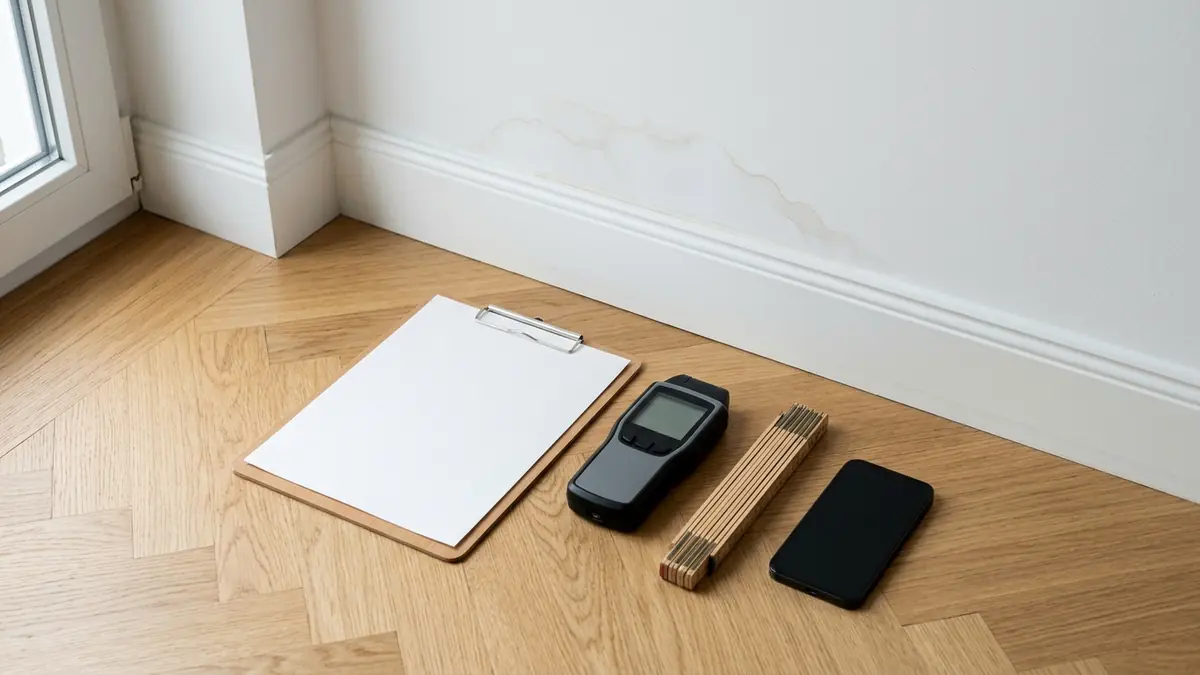
After a burst pipe, a fire or a burglary, your insurer calls: a loss adjuster (Gutachter or Schadenregulierer) wants to look at the damage. Many people feel as if they are being tested. In fact you have clear duties during this visit, and just as clear rights. This guide explains who is coming and who they work for, what you may and may not do beforehand, what you have to say and sign during the visit, and when it is worth bringing in your own expert.
Who is coming and who they work for
For smaller claims, photos, invoices and a repair quote are usually enough. Above a certain amount, when the cause is unclear or when details do not add up, the insurer sends someone. That can be one of its own field claims staff or an external expert the insurer instructs. With water damage, a leak detection and drying company often comes first.
These people work on behalf of the insurer and are paid by it. A reputable expert assesses the damage objectively. But they are not your expert, and their assessment is not a decision. The insurer decides on the payout, and you can challenge that decision. The insurer bears the cost of its own adjuster, so you pay nothing for the visit.
Before the visit: limit the damage, but do not get rid of anything
Two duties seem to pull in opposite directions here. Under § 82 of the German Insurance Contract Act (VVG) you must keep the damage as small as possible. At the same time, the conditions of German household contents (Hausrat) and building (Wohngebäude) insurance almost always require you to leave the damage unchanged until the insurer has released the site. Both fit together if you proceed like this:
- Emergency measures straight away: turn off the water, make the electrics safe, mop up, close windows temporarily, have an emergency roof fitted. Whatever is needed to prevent further damage, you may and must do. The insurer reimburses these costs under § 83 VVG, even if the measure did not work in the end.
- Photograph everything first: before you change anything, take photos and short videos, close up and as an overview. With water damage, include the damp marks, the source of the leak and affected furniture.
- Do not edit the photos: no filters, no cropping, no brightening and no AI retouching. The date, time and often the location are stored in the metadata of the original file, and that is what proves when you took the photo. An edited image quickly raises the suspicion that something was touched up. Send the insurer the originals, ideally by email or upload as a file, because messenger apps shrink images and strip the metadata. If you need a close-up crop, send it in addition and label it as such.
- Keep damaged items: do not throw away soaked carpets, broken appliances or a burst piece of pipe until the insurer has seen them or released them. If something has to go because of mould or smell, check with the insurer briefly first and document it.
- No repairs before approval: larger work such as opening walls, new flooring or replacing the heating waits until the adjuster has been or the insurer has agreed in writing.
Use the time before the visit to gather documents: a list of damaged or stolen items with year of purchase and price, receipts, photos from before the damage, repair quotes, and for buildings the year of construction, renovations and tradespeople's invoices. After a burglary, send the police a list of stolen items (Stehlgutliste) without delay, which the policy conditions require explicitly. How to put together the claim report itself is explained in the guide How to file an insurance claim that gets paid.
During the visit: what you have to do and what you don't
You have to give the insurer any information it needs to establish the loss and allow it to examine the cause and amount (§ 31 VVG and the duties in your policy conditions). If you conceal something or give false information, the insurer may be released from paying in full or in part (§ 28 VVG). That does not mean you have to sit back and let the visit happen to you.
- Agree on the appointment: the date has to work for you. You may suggest another day, but you should not delay the inspection unnecessarily.
- Bring someone along: you can have a person you trust with you, such as your partner, the tradesperson who knows the damage, or your insurance broker. A second person listens and can later confirm what was said. If your German is not strong, this person can also help with the language.
- Stick to facts: describe what you saw and did. When asked about the cause or the condition of pipes or the roof, you do not have to guess. "I don't know" is an honest answer. Guesses quickly end up as facts in the report.
- Take your own notes: write down who was there, what was inspected, which photos and measurements were taken and what the adjuster said. Photograph the spots they look at as well.
- Do not sign anything on the spot you do not understand: you do not have to sign a settlement (Abfindungserklärung), a waiver of further claims or an agreement on the amount during the visit. Ask for a copy and check it in your own time.
- Get promises in writing: if the adjuster says you can start repairs or mentions an amount, ask the insurer to confirm it in text form. Verbal statements by the adjuster do not necessarily bind the insurer.
You do not automatically receive the adjuster's report. There is no explicit statutory right to a copy in property insurance, but many insurers send it on request anyway. At the latest when the insurer cuts or refuses the payout, ask for it in writing, because without the report you can hardly check the reasoning. Under Art. 15 GDPR you can also request access to the data the insurer holds about you and your claim.
The adjuster often recommends a partner company for drying or restoration. That can be convenient, because billing then goes directly through the insurer. You are usually not obliged to use them, unless your policy explicitly says the insurer organises the repair itself. If you hire your own tradespeople, the insurer reimburses the costs needed for the repair. For larger work, get a quote first and send it to the insurer.
What people often disagree about after the visit
Once the report is in, the insurer's letter with its settlement follows. The points of dispute are almost always the same:
- Cause: was it covered water damage from a pipe or groundwater coming in? A storm of wind force 8 or more, or an old, leaking roof? This decides whether anything is paid at all. If you doubt the finding, a statement from your tradesperson or your own expert often helps.
- New value or current value: household contents insurance normally pays the replacement price for new items of the same kind and quality. In building insurance, the insurer usually only pays the part above the current value (Zeitwert) once you rebuild within three years or the rebuild is secured. Check your conditions before you accept a settlement based on current value.
- Underinsurance: if the sum insured is too low, the insurer may reduce the payout proportionally (§ 75 VVG). Many policies include a waiver of underinsurance, for example with a contents sum based on living space or with sliding new value (gleitender Neuwert) for buildings. Why the flat rate is not always enough is explained in the guide on the underinsurance trap in household contents insurance.
- Previous damage and wear: adjusters like to deduct shares because parts were already old or damaged. Photos from before the damage and invoices for renovations are your best argument here.
- Gross negligence: if you caused the damage through gross negligence, the insurer may reduce the payout (§ 81 VVG). Many newer policies waive this entirely or up to a certain amount.
Your own expert: when it pays off and who pays
With major damage to a house, after a fire or when the insurer's report is far below your tradespeople's quotes, your own expert can be worth it. They can assess the damage independently, check the insurer's report and talk to the insurer's adjuster as an equal.
In property insurance, however, you usually bear the cost yourself. Under § 85(2) VVG the insurer only reimburses the cost of an expert or adviser you bring in if your contract obliges you to or the insurer asked you to. Some policies include a clause on expert costs (Sachverständigenkosten) and cover part of them above a certain claim amount. Whether yours does is stated in the policy schedule or in the conditions under "costs" (Kosten).
When choosing, look for an expert in the right field, for example one publicly appointed and sworn (öffentlich bestellt und vereidigt) by the chamber of commerce (IHK) or the chamber of crafts (Handwerkskammer). Ask about the fee before you hire them and whether they charge by the hour or by claim amount. With damage of a few thousand euros, the fee can quickly eat up any extra amount you might get.
Car accidents work differently
If someone else caused the accident, it is a liability claim, not a claim on your own insurance. You may then hire an independent motor vehicle expert yourself, and the other driver's liability insurer has to reimburse the cost as part of the damage. For minor damage below roughly 750 euros, a repair quote is usually enough. You do not have to accept the expert the other side's insurer offers you. What else matters after an accident is on the page about car insurance.
The expert procedure: when you cannot agree on the amount
The conditions of German household contents and building insurance almost always include a separate procedure (Sachverständigenverfahren) for when you and the insurer disagree about the amount of the loss. You can demand it after the loss, or you can agree on it together. Under the usual conditions it works like this:
- Two experts: each side appoints an expert in text form. If the insurer does not name its expert within two weeks of your request, you can have the local court (Amtsgericht) where the loss occurred appoint one. The same applies the other way round.
- An umpire: before they start, both experts appoint a third expert as umpire (Obmann). If they cannot agree, the local court appoints one.
- Separate findings: both experts assess the loss, for example the damaged items, their value before the loss and the repair costs. If their results differ, the umpire decides within the range the two of them set.
- Binding result: the findings are binding on both sides. A court can only correct them if they obviously and considerably deviate from the actual facts (§ 84 VVG).
- Costs: each side pays its own expert, and the umpire's costs are shared, unless your contract says otherwise.
The procedure only settles the amount of the loss, unless you expressly agree to extend it. If the insurer disputes that there is a covered loss at all, it will not help you. Then the next steps are an appeal, the ombudsman or a court case, as described in the guide Insurance claim denied: how to appeal, ombudsman and BaFin. Your contractual duties, such as the duty to provide information, continue during the procedure.
When the claim drags on
Weeks have passed since the visit and you have heard nothing? Ask in writing about the status and which documents are still missing. Keep a record of every question and answer with the date. The payout becomes due once the insurer has completed the necessary enquiries (§ 14(1) VVG). If the claim was reported more than a month ago and the review is not finished, you can demand an advance payment of the amount the insurer is likely to owe at least (§ 14(2) VVG). With major building damage, that is often the money you use to pay the first tradespeople.
You need not worry much about the limitation period during this time. As long as the insurer has not decided on your reported claim in text form, it is suspended (§ 15 VVG). Once the decision has been made, the period runs again, so you should not wait long after that.
If your policy is managed by me
Then get in touch as soon as the insurer announces an adjuster, via WhatsApp, email or the simplr app. As an insurance broker I represent your interests, not the insurer's. I go through your policy conditions with you, talk through which documents should be ready and help you, as far as I can, with reporting the claim and answering follow-up questions, in English or German. The insurer decides on the payout.
If the insurer refuses after the report, cuts the payout or drags out the claim for many months, I can bring in the claims service of Maxpool. Maxpool is the broker pool I work with. Its claims service reviews disputed cases with its own specialists and deals with the insurer with the weight of a large broker pool behind it. Nobody can promise a particular outcome, but you do not face the insurer on your own.
The service only covers policies managed by me, meaning policies you took out through me or transferred into my care. If your household contents insurance or building insurance is still managed elsewhere, a quiet moment without a claim is the right time to transfer it. If you would like to do that, get in touch. The policy itself stays exactly as it is, premium and conditions included. What else I take on when you have a claim, and where my help ends, is explained in the guide on claims management.
Checklist: when the loss adjuster comes
- Have you taken all emergency measures to limit the damage and kept proof of the costs?
- Is the damage documented with unedited original photos, and are you keeping damaged items until they are released?
- Are your list of damaged items, receipts, photos from before and repair quotes ready?
- Will a second person be there, and are you taking your own notes?
- Are you sticking to what you know and leaving out guesses about the cause?
- Will you refuse to sign any settlement or waiver before checking it in your own time?
- Have you asked for a copy of the report, and remembered the advance payment after one month?