
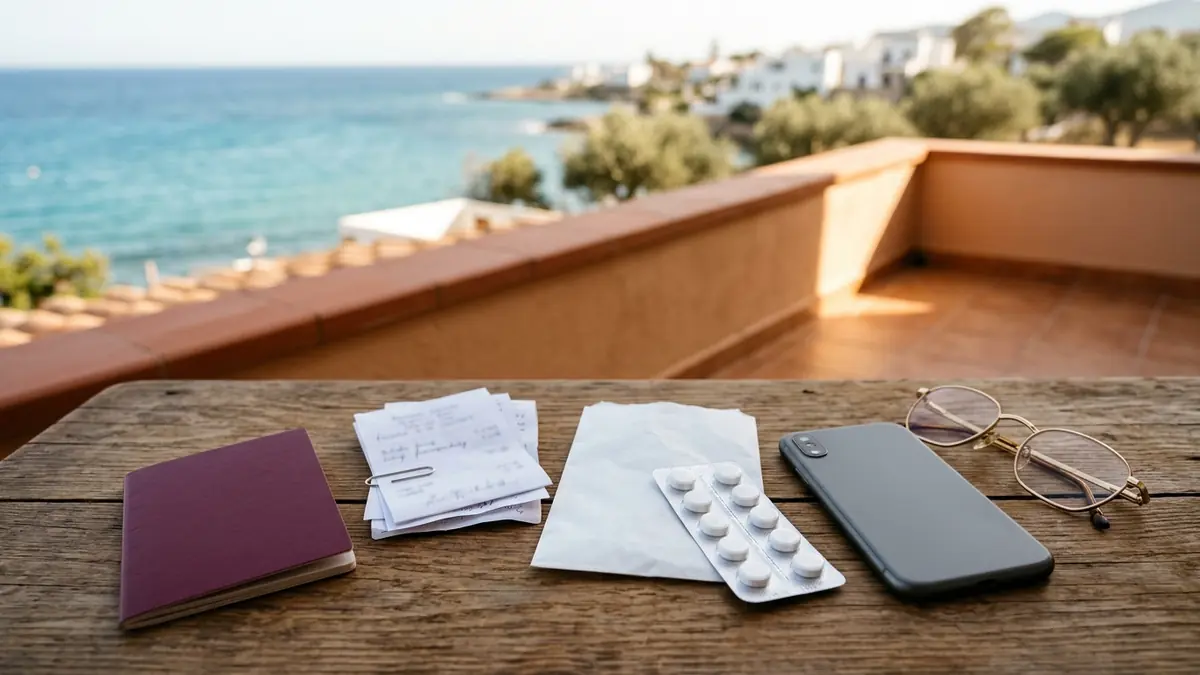
When you fall ill on holiday, paperwork is the last thing on your mind. Still, whether you get your money back is mostly decided on the spot: if you call the right number, take complete bills with you and do not book a flight home on your own, the refund is usually straightforward. Here I explain what your German health insurance pays abroad, when you need your insurer's assistance service, which receipts to collect and how the reimbursement works afterwards.
What German public health insurance pays abroad
The back of your German health card is the European Health Insurance Card, or EHIC. With it you get medically necessary treatment in the EU, Iceland, Liechtenstein, Norway, Switzerland and the United Kingdom, on the same terms as people insured in the public system there. That sounds like full cover, but there are three catches:
- Local co-payments: If the host country charges patients a share, such as a fixed percentage for a doctor's visit or a daily hospital fee, you pay it yourself. Your Krankenkasse does not refund it.
- Only doctors in the public system: Many hotels and tour guides send holidaymakers to private practices or private clinics. The EHIC does not work there, and you get a private bill.
- Refund only up to German rates: If you pay yourself because the doctor does not accept the card, your Krankenkasse refunds at most what the treatment would have cost in Germany, minus a deduction for administrative costs (§ 13(4) SGB V). With private bills, the larger part often stays with you.
Germany has a social security agreement with some countries outside the EU, for example Turkey, Tunisia, Serbia and Bosnia and Herzegovina. There you need a certificate of entitlement from your Krankenkasse, which you request before you travel, and similar limits apply as with the EHIC. In all other countries, such as the USA, Thailand, India or Egypt, German public health insurance usually pays nothing. It never pays for repatriation to Germany, wherever you are.
Travel health insurance closes these gaps. Under its conditions it pays the costs that public insurance does not, including private doctors, and the transport home. As an annual policy for one person it often costs only a low two-digit amount per year and covers any number of trips up to a maximum length, depending on the tariff for example six or eight weeks at a time. If you have private health insurance (PKV), check your conditions: many PKV tariffs cover Europe without a time limit but the rest of the world only for a limited period, and repatriation is frequently missing.
On the spot: when to call the assistance service
In an emergency, call an ambulance first, using 112 anywhere in the EU. After that comes the most important number of your trip: the emergency line of the assistance service of your travel health insurance. You will find it on your insurance card, in your policy documents or in your insurer's app. Save it on your phone before you leave, for every family member.
- Hospital stay: Call as soon as it is clear that you will be admitted. The assistance service usually sends the hospital a guarantee of payment, and the hospital then bills the insurer directly. Many policies require you to report a hospital stay without delay.
- High costs or payment upfront: If a clinic asks for money or a credit card as a deposit, the assistance service can help with a payment guarantee. Some insurers also transfer an advance.
- Repatriation: Do not arrange a flight home yourself. Whether and how you are brought back to Germany is decided by the assistance doctors together with the doctors treating you. If you book on your own, the insurer may in the worst case pay only part of the cost or nothing at all.
- Which doctor: The assistance service can name doctors and clinics it works with, often ones that speak English or German. That saves you paying upfront and translating bills.
For a visit to a GP because of an ear infection or an upset stomach you do not have to call anyone. You usually pay smaller amounts yourself on the spot, by card or in cash, and submit them after the trip. What matters then is that you take the right paperwork with you.
Which receipts you need
Most rejections and follow-up questions after a trip have a simple cause: the bill is incomplete. A receipt for 120 euros without a diagnosis cannot be checked, and two weeks later the practice is hard to reach from home. So ask for a complete bill while you are still there. It should show:
- Who was treated: First name, surname and date of birth of the patient, so for children the child and not the parent who paid.
- Who treated you: Name, address and stamp of the doctor or clinic.
- What was treated: The diagnosis, the date of treatment and the individual services with prices, plus the total and the currency.
- Medication: The prescription and the pharmacy receipt showing the name of the medicine. A till receipt without the product name is often not enough.
- Proof of payment: A receipt or credit card slip. Many policies convert foreign currencies at the rate on the day the documents reach the insurer. If you add your credit card statement, you can prove the amount you actually paid.
- For repatriation or a hospital stay: The discharge report or a short medical report. Your GP in Germany will find it useful too.
Take a photo of every document straight away. Paper gets lost easily when travelling, and many insurers now accept bills through an app or upload. Keep the originals anyway until the refund has been paid, as some insurers ask for them in individual cases. Many insurers accept bills in English and in common holiday languages without a translation. Some conditions allow the insurer to deduct translation costs from the refund, so ask before you pay a translator.
An example: Kerstin's autumn holiday in Mallorca
Kerstin, 43, a nursery teacher, is in Mallorca with her husband and their two children during the autumn school holidays. On the third day her son gets a high fever and earache. The hotel reception sends the family to a clinic close by. Nobody there accepts the health card, because it is a private clinic. The bill for the examination, an antibiotic and a follow-up check two days later comes to 480 euros.
Kerstin pays by credit card and asks at the front desk for a bill with her son's name, the diagnosis and the individual items. She photographs the prescription and the pharmacy receipt the same evening. Back home, she submits everything through the app of her travel health insurance, which runs on a family tariff.
After just under three weeks the 480 euros are in her account. Without travel health insurance she would have sent the bill to her Krankenkasse and received only what the treatment by a paediatrician in Germany would have cost, minus administrative costs. She would have had to pay the rest herself.
After the trip: how to submit
Submit your documents soon after you get back, while you still know which receipt belongs to which visit. Legally your claims only become time-barred after three years (§ 195 BGB), but questions are much easier to clear up after a few weeks than after a year. The order is simple:
- Check your conditions: Find out whether you may submit the bill directly to your travel health insurance or must claim from your Krankenkasse first. Many policies let you submit directly and recover the Krankenkasse's share themselves.
- Form and documents: Fill in the claim form or the screen in the app, upload all bills, prescriptions, proof of payment and reports, and add your bank details. Write two or three sentences on what happened and when the symptoms started.
- Krankenkasse: If you have no travel health insurance or it requires this, you submit the bills to your Krankenkasse. It refunds up to the German rate. You can then send the rest to your travel health insurance together with the Krankenkasse's statement.
- Answer follow-up questions: If the insurer asks for more documents, send them promptly. Payment only becomes due once it has everything it needs to assess the claim (§ 14 VVG).
Two topics often lead to questions. The first is pre-existing conditions: travel health insurance pays for acute, unforeseen illness and accidents. If you travel with a known condition and are treated for it there, you may run into trouble if the conditions exclude it. Stay truthful in everything you state and leave nothing out. The second is dental work: usually only pain relief, simple fillings and repairs are covered, not a new crown.
If you are an expat insured in Germany and you travel to your home country, read the conditions closely. Some policies restrict cover in the country whose citizenship you hold or where you have another residence. And if your family comes to visit you from abroad, your guests need their own incoming health insurance; your German insurance does not cover them.
When the refund gets stuck
If the insurer pays less than you expected, look at the statement first. Often a single document is missing, or one item is not covered under the conditions, such as a single room or a medicine you bought without a prescription. How to write a factual appeal and when the insurance ombudsman can help is explained in the guide Claim denied. How to report a claim completely from the start is covered in How to file an insurance claim.
If your travel health insurance is managed by me, send me the statement and your receipts via WhatsApp, email or the simplr app. I look at what is missing with you and help you, as far as I can, to submit the bills completely and correctly, in English or German. The insurer decides on the refund. If it refuses, cuts the payment or the assessment drags on, I can bring in the Maxpool benefits service for policies in my portfolio, but nobody can promise an outcome. What else I take on when you have a claim is described in the guide on claims management.
The best time for these questions is before you leave. Check whether you have travel health insurance, who it covers, how long a single trip may last and whether repatriation is paid when it is medically advisable or only when it is medically necessary. When you book anyway, also look at trip cancellation and interruption insurance, because health insurance does not pay cancellation fees. If you are new to Germany, you will find more tips in the guide Insurance when relocating to Germany.
Checklist: sick abroad
- Before the trip: travel health insurance in place for everyone travelling and the assistance number saved on your phone?
- Health card with EHIC packed and, for agreement countries, the certificate of entitlement requested from your Krankenkasse?
- Assistance service called straight away for a hospital stay or high costs?
- No flight home booked yourself, repatriation arranged through the assistance service?
- Bills requested with name, date of birth, diagnosis, date and individual services?
- Prescriptions, pharmacy receipts and proof of payment photographed and originals kept?
- Checked in your conditions whether the Krankenkasse or the travel health insurance comes first?
- Documents submitted soon after returning and follow-up questions answered promptly?