
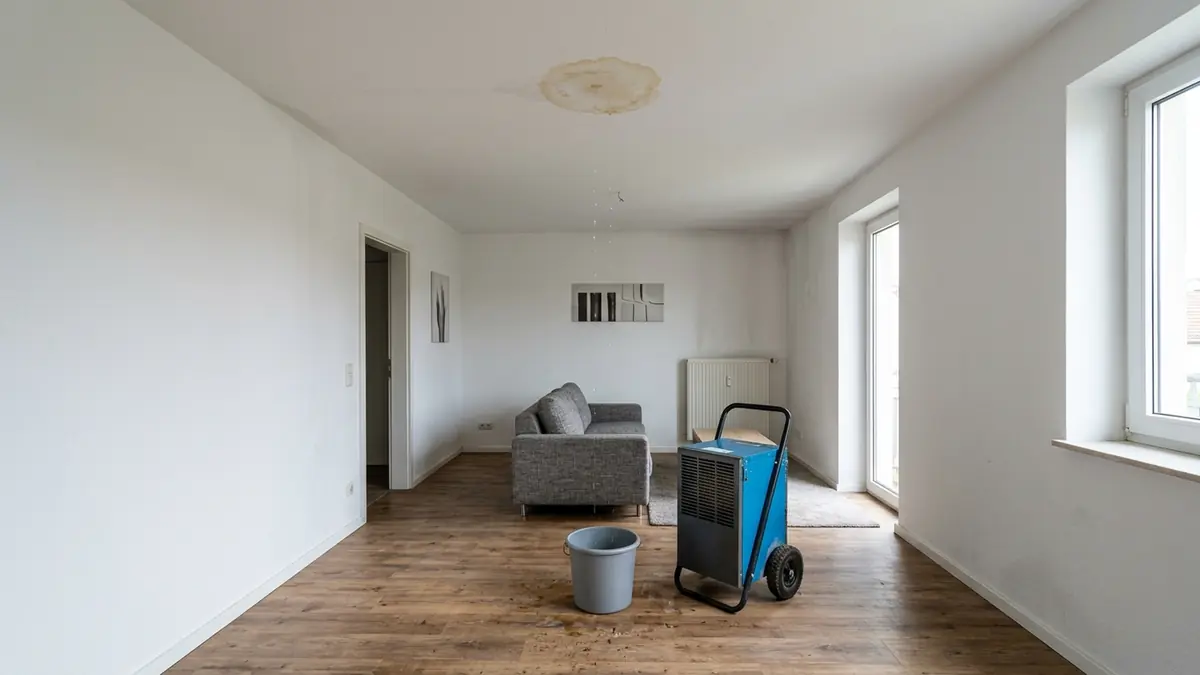
Leaking tap water is one of the most common types of damage in a home, and in a German block of flats there are almost always several insurers involved: your contents insurance, the landlord's building insurance, perhaps your private liability insurance or your neighbour's. Who pays for what depends less on who was at fault than many people think. This guide explains which policy covers which part of the damage, what to do in the first few hours and what applies to drying, rent reduction and hotel costs.
The basic rule: everyone insures what they own
With water damage in a rented flat, the claim is split according to who owns the damaged item. That sounds obvious, but keeping it in mind from the start saves you a lot of arguments.
- Your household contents insurance (Hausratversicherung): it pays for everything you would take with you when you move out: furniture, rugs, clothes, books, electronics and food. It also covers fittings you bought yourself as a tenant, such as your own fitted kitchen or flooring you laid at your own expense. You get the replacement value, meaning the price of new items of the same kind and quality.
- The landlord's building insurance (Wohngebäudeversicherung): it pays for the building and everything permanently part of it: walls, ceilings, screed, the landlord's flooring, doors, pipes, heating and sanitary fittings. Finding the leak, opening up the wall and drying the masonry are also covered here. The landlord may pass the premium on to you through the service charges (§ 2 No. 13 BetrKV, the German operating costs ordinance).
- Private liability insurance (Privathaftpflicht): it only comes in when someone caused the damage and has to compensate another person (§ 823 of the German Civil Code, BGB). It pays for other people's damage, never your own.
Contents and building insurance cover tap water (Leitungswasser), meaning water that escapes unintentionally from pipes, heating, washing machines, dishwashers or other appliances connected to the plumbing. Rain coming through a leaking roof, groundwater in the basement or water pushed back up through the drains in heavy rain is not included. That needs the natural hazards add-on (Elementarschaden), which many policies lack.
Fault matters less than you think
The first question after water damage is usually: whose fault was it? For your own belongings it hardly matters. Your contents insurance pays whether you caused the damage, the neighbour did or nobody did. The typical cases look like this:
- A pipe in the wall bursts: nobody is at fault. Your belongings are paid by your contents insurance, everything else by the landlord's building insurance. The landlord is usually only liable for your furniture if they neglected something, for example did not have a dripping connection repaired after you reported it (§ 536a BGB).
- The water comes from the flat above: you still report your belongings to your own contents insurance. You do not have to establish first whether the neighbour was at fault. If they were, your insurer recovers the money from them or their liability insurer later (§ 86 of the German Insurance Contract Act, VVG).
- Your washing machine leaks: your belongings are paid by your contents insurance. The damage to the building is covered by the landlord's building insurance. Because you pay its premium through the service charges, it may not claim the money back from you for simple negligence. The German Federal Court of Justice decided this years ago (judgment of 8 November 2000, IV ZR 298/99). Damage in the flat below and damage to the rented property that the building insurance does not cover is paid by your private liability insurance, as long as it includes damage to rented property (Mietsachschäden).
- You let the bath fill up and go shopping: that can be gross negligence. Then the landlord's building insurer may claim the money back from you, and your contents insurer may reduce its payout (§ 81 VVG) unless your policy waives this defence. Private liability insurance pays even for gross negligence; only intent is excluded (§ 103 VVG).
Without contents insurance you are left with the cost of your own belongings in almost every case. Neither the landlord nor their insurer replaces a soaked sofa if nobody was at fault. And without private liability insurance you pay for the damage downstairs yourself if your dishwasher leaked. For tenants, these two policies are the basic kit. More on this in the guide Do I need liability insurance in Germany?
An example: Merle's ceiling is dripping
Merle, 31, rents a flat on the second floor of an old building in Münster. One Saturday evening a dark stain appears on her living room ceiling, and soon water is dripping onto her sofa and the laptop on the coffee table. In the flat above, the inlet hose of the washing machine has come loose.
Merle rings the neighbour's bell, and the neighbour turns off the tap. She puts a bucket underneath, pushes the sofa aside, photographs the ceiling, sofa and laptop and sends a message to the property management that same evening. On Monday she reports the damage to her contents insurer.
Her contents insurance replaces the sofa and laptop at replacement value. The ceiling, the laminate and three weeks of drying are paid by the landlord's building insurance, and Merle claims the electricity for the dryers through the property management using her photos of the meter readings. Because she can hardly use the living room during that time, she reduces her rent. Whether the neighbour connected the hose badly is for the insurers to sort out between themselves, not for Merle.
The first few hours: what to do straight away
Under § 82 VVG you must keep the damage as small as possible, and as a tenant you must inform the landlord of the defect without delay (§ 536c BGB). If you put this off, you risk being liable for the consequential damage yourself and losing the right to reduce your rent. In practice that means:
- Stop the water: turn off the main stopcock or the valve under the sink. If the water comes from above, ring the neighbour's bell. If nobody is in, call the property management or its emergency line.
- Make the electrics safe: if water is running near sockets, lights or the fuse box, switch off the circuit for that room.
- Inform the landlord: immediately and ideally in writing, by email or message with photos. The landlord arranges the repair of the building and the drying.
- Deal with an emergency yourself if nobody can be reached: if the landlord cannot be reached and further damage is likely, you may call an emergency plumber. The landlord has to reimburse you (§ 536a(2) BGB). Ask for the work done and the cause to be stated on the invoice.
- Take photos before you tidy up: ceiling, walls, floor, the source of the leak and every damaged item. Then move furniture away, lift rugs, unplug electronics and let them dry. Do not throw damaged items away until the insurer has seen them or released them.
- Report it to your contents insurer: without delay, with photos and a first list of damaged items. How to structure the report is explained in the guide How to file an insurance claim that gets paid. If you caused the damage yourself, report it to your private liability insurer as well.
For larger claims the insurer often sends a loss adjuster, or first a leak detection company. What you have to say and sign during that visit is covered in the guide The insurer's loss adjuster is coming.
Drying, electricity and mould
After a major leak, industrial dryers often stand in the flat for two to four weeks. They are loud, heat up the room and use a lot of electricity. They are ordered by the landlord or the landlord's insurer, and the drying costs are part of the building claim. That includes the electricity running through your meter. Photograph the meter reading when the machines are set up and again when they are collected. Many drying companies note the running time or consumption of their machines in their report. With both, you claim the extra cost from your landlord.
Do not switch the machines off on your own because they are annoying. If the wall stays damp and mould forms, it quickly gets expensive, and the insurer will ask who interrupted the drying. If you still see dark patches or notice a musty smell after the machines have gone, report it to the landlord at once. Mould resulting from an insured water leak is part of the claim. Mould caused by too little ventilation is not, and that is exactly what people tend to argue about later. Dated photos from the drying period help you here.
Rent reduction and hotel costs
If your flat is less usable because of the damage, the rent is reduced by law for as long as the defect lasts (§ 536 BGB). The landlord does not have to be at fault for this. How much the reduction is depends on how badly you are affected: a damp patch in the hallway is different from a living room with dryers running for three weeks. With drying in progress, German courts have often considered between 10 and 30 percent appropriate depending on the extent, and up to 100 percent for a flat that cannot be lived in. If you caused the damage yourself, you may not reduce the rent.
Do not simply withhold an amount you think is fair. If the reduction is too high, you fall into rent arrears. It is safer to pay the full rent under reservation (unter Vorbehalt), tell the landlord so in writing and reclaim the overpaid rent later. If you are unsure, a tenants' association (Mieterverein) or your legal expenses insurance can help, if it includes tenancy law cover.
If the flat cannot be lived in at all, many contents insurance policies pay hotel or accommodation costs, usually for a limited number of days and up to a daily amount. Many policies also cover transport and storage of your furniture if it has to be moved out during the renovation. Agree this with the insurer beforehand and keep all receipts.
And if you are the landlord?
As a landlord you have to restore the flat to the condition agreed in the tenancy (§ 535(1) BGB), even before it is clear whether and how much your insurer will pay. Report the damage to your building insurance straight away, arrange leak detection and drying and keep your tenant informed about appointments. Many policies also pay for loss of rent if the flat becomes uninhabitable after an insured loss, usually for up to twelve months.
If your tenant caused the damage through simple negligence, the case law of the Federal Court of Justice says you may not claim against them directly if your building insurance covers the damage and they pay its premium through the service charges. You then have to turn to your insurer. If the flat is part of a condominium (Eigentümergemeinschaft), damage to the common property goes through the building insurance the property management has taken out for the owners.
If your policy is managed by me
Then send me the photos and a short description via WhatsApp, email or the simplr app. I work out with you which of your policies is responsible and help you, as far as I can, to report the claim correctly and on time, in English or German. The insurer decides on the payout. If it refuses, cuts the payout or drags out the claim, I can bring in the claims service of Maxpool for policies managed by me, but nobody can promise a particular outcome. What else I do when you have a claim is described in the guide on claims support.
The best time to look at your policies is before anything happens. Check whether your household contents insurance has a high enough sum insured (see the guide on the underinsurance trap) and whether your private liability insurance covers damage to rented property and water damage without a low limit.
Checklist: water damage in a rented flat
- Is the water turned off and the electricity in the affected room made safe?
- Have you informed the landlord or property management immediately, in writing and with photos?
- Have you photographed the source, ceiling, walls, floor and all damaged items before tidying up?
- Have you reported your own belongings to your contents insurer, even if the water came from the neighbour?
- Did you cause the damage yourself, and have you therefore also reported it to your private liability insurer?
- Have you photographed the meter readings at the start and end of the drying?
- Are you paying the rent under reservation and recording how long the flat was only partly usable?